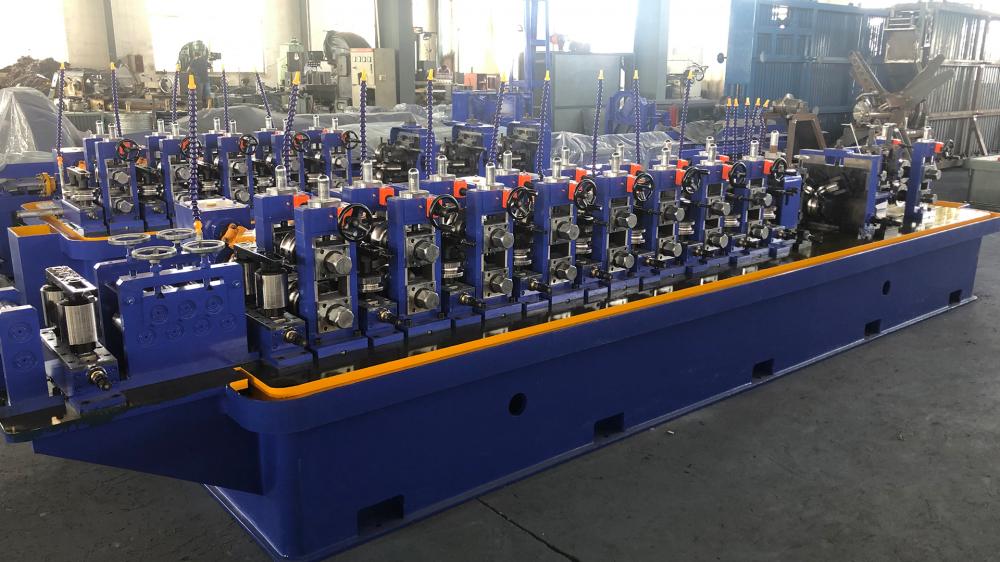
For decades, a tube mill was a one‑trick pony. You set it up for round pipe, and it made round pipe. Square tube? That meant a different set of forming rolls, a different pass schedule, and days of downtime to swap everything out. The mill would sit idle while the maintenance crew wrestled with heavy roller stands and recalibrated every station. That rigidity cost manufacturers millions in lost production and tied up floor space with dedicated lines.
Today, the forming section of a modern steel tube mill machine is rewriting that rulebook. The design philosophy has shifted from fixed‑pass to flexible. The new generation of forming stands uses cartridge‑type roll assemblies that slide in and out on rails. You can pull an entire set of forming rolls for round tube and replace it with a square‑tube configuration in under 30 minutes. Some advanced mills now achieve profile changeovers in as little as 15 minutes, compared to the traditional 8‑hour ordeal. That is a reduction of over 90% in downtime per transition.
One Midwestern tube producer tracked their changeover data over a six‑month period. With their old mill, they averaged 4.2 changeovers per month, losing 2.5 shifts each time. After upgrading to a cassette‑style forming section, they now run 11 changeovers per month with an average downtime of 28 minutes per switch. That boosted their monthly output from 420 tons to 890 tons without adding any extra shifts. The flexible forming section alone paid for itself in nine months.
The technology behind this is not magic — it is precision engineering. Roll forming machines that handle both round and square profiles rely on universal stands with interchangeable tooling. The stands are driven by independent servo motors that allow real‑time gap adjustments. When a mill switches from a 2‑inch round to a 1.5‑inch square, the control system calls up a preset forming sequence. The top and bottom rolls move simultaneously, and the side rolls close in to create the sharp corners. The entire process is automated, with laser sensors verifying the cross‑section before the first piece enters the welding section.
But flexibility is not just about shape. It is also about material. A roll forming machine that can process steel can also handle aluminum tube — provided the forming rolls have the right surface finish and the lubrication system can be adjusted. Aluminum is softer and more prone to scratching, so the same forming section may need different roll coatings or reduced pressure settings. Mills that invest in quick‑change forming sections often pair them with a second set of rolls optimized for non‑ferrous metals. One European manufacturer reported that their flexible mill now runs steel pipe Monday through Thursday and switches to aluminum tube over the weekend, keeping the line profitable even with smaller batch sizes.
The industry is waking up to a simple truth: the fixed‑pass mill belongs in a museum. Today's market demands short runs, just‑in‑time delivery, and the ability to pivot between product families without losing a shift. The forming section is no longer the bottleneck — it is the enabler. And the mill that cannot change shape is the mill that cannot compete.