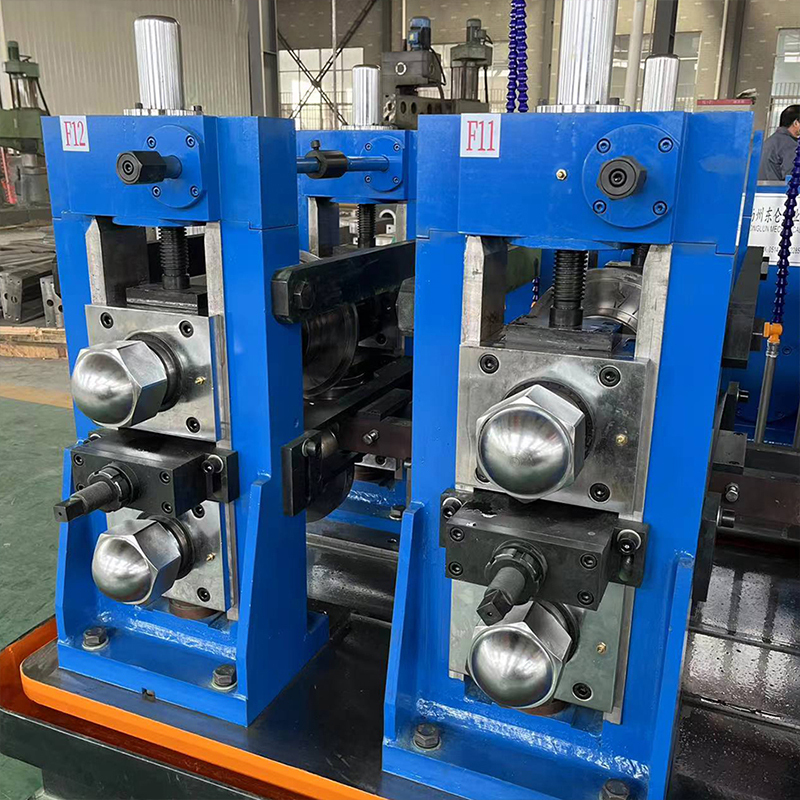
Walk onto the floor of any modern metal processing plant, and you will see the same shift happening everywhere. The old roll forming lines—noisy, rigid, and painfully slow—are being replaced by machines that run faster, cut more precisely, and switch profiles in minutes rather than hours.
The numbers tell the story. Next-generation roll forming machines now achieve sustained production speeds of 70 meters per minute. Some high-speed models push even further—up to 100 meters per minute for large-scale manufacturing. That translates to 23 panels per minute for standard 3-meter profiles. A production line that once output 500 units per shift can now push 1,200. The throughput gains are not incremental—they are transformative.
Speed alone is not enough. The real breakthrough is CNC precision running at those speeds. Modern servo-driven roller systems adjust in real time to maintain exact tolerances—often within 0.1 mm. Closed-loop feedback systems with inline laser measurement continuously monitor profile geometry; if a deviation is detected, the system adjusts roll gaps automatically and instantly. The result is components with uniform thickness, accurate bends, and surface finishes that meet the most stringent industry standards. Scrap rates drop to near zero.
The same machine now handles materials that would have choked older lines. Advanced high-strength steels (AHSS) and ultra-high-strength steels (UHSS) with yield strengths of 550–960 MPa are increasingly specified in automotive and construction applications. Standard machines cannot handle those loads—but next-gen roll forming lines use heavy-duty steel plate fabrications and Cr12MoV shafts to prevent deflection.
For aluminum tube production, the challenges are different but equally demanding. Roll forming high-strength AA7075 aluminum brings difficulties not seen with standard steel grades—early fracture due to low ductility, higher springback, and redundant deformation. Yet aluminum is about one-third the weight of carbon steel, making it the preferred choice for lightweight automotive components and portable equipment. Next-gen roll forming machines adapt to these material characteristics with modular designs that allow easy adjustment of roller spacing, pressure, and speed.
Carbon steel tube mills tell a different story. An ERW tube roll forming machine processing carbon steel pipe in the Φ219–Φ273 mm range typically runs at 10–30 m/min—slower than lighter-gauge profile lines, but with wall thicknesses up to 10 mm and the structural integrity that heavy-duty applications demand. The process is proven, robust, and industrial-grade.
The global roll forming machine market reflects this transformation. Valued at approximately $10.1 billion in 2026, it is projected to reach $12.76 billion by 2033. The automotive industry's increasing demand for lightweight structural components and the continued expansion of residential and commercial construction are driving sustained growth.
The old roll forming line—rigid, slow, and labour-intensive—is being retired. The new standard is 70 m/min, CNC precision, and the flexibility to switch between steel, aluminum, and high-strength alloys without losing a shift. Speed without precision is waste. Precision without speed is obsolete. Next-gen roll forming machines deliver both.