Walk onto the floor of any pipe mill, and you will see two very different pictures. On one side, an ERW line runs continuously — coil feeding in, pipe coming out the other end at a steady clip. On the other, a seamless operation works in batches: heat a billet to 1,200°C, pierce it, roll it, inspect it. One never stops. The other stops constantly.
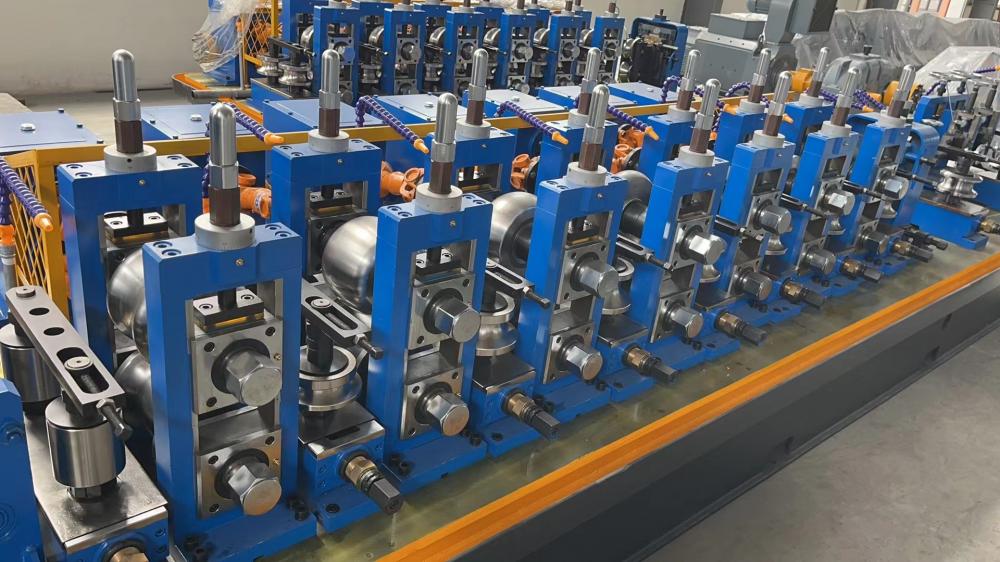
The productivity gap is not subtle. An ERW steel tube mill machine transforms steel coils into welded pipe through a continuous forming and welding process. Top-tier lines achieve production speeds of 10 to 120 meters per minute. One ERW line can produce 550 tons per day — roughly seven times the output of a seamless line, which averages just 80 tons daily. The energy numbers tell the same story: ERW consumes only 85 kWh per ton, while seamless burns through 220 kWh. That is less than 40% of the energy for the same tonnage.
The cost advantage compounds from there. ERW's material utilization reaches 95.2%, compared to 82-85% for seamless. On a 10,000‑ton order, that saves over 1,000 tons of steel. Processing costs for ERW run 250‑300 yuan per ton, versus 600‑800 yuan for seamless. The cycle time difference is even starker: ERW takes 1‑2 hours per ton; seamless requires 8‑12 hours. A project manager choosing ERW where specifications allow can cut the pipe procurement budget by 15‑25%.
But productivity is not just about speed. It is about precision. ERW steel tube mill machines deliver tighter dimensional tolerances — ±0.5% on outside diameter versus ±1% for seamless. Modern roll forming machines, with servo‑controlled gap adjustments and quick‑change cartridge systems, enable profile transitions in under 30 minutes. Some advanced mills now achieve line speeds exceeding 120 meters per minute for light‑gauge tubes, with yields above 98%.
Does this mean seamless is obsolete? Hardly. For high‑pressure downhole operations, sour H₂S environments, and temperatures above 427°C, seamless remains the specification. The absence of a weld seam gives it superior burst strength and fatigue resistance under cyclic pressure. But for the vast majority of oil and gas gathering systems, transmission pipelines, and structural applications, ERW delivers the productivity that seamless simply cannot match.
What about aluminum tube? The same roll forming principles apply — but aluminum demands a lighter touch. Roll forming machines processing aluminum require smooth forming rolls, precise speed control, and adaptive calibration to minimize surface scratches while maintaining dimensional accuracy. A roll forming machine that handles both steel and aluminum opens production flexibility that single‑material mills cannot match.
The choice between ERW and seamless is not about which pipe is "better." It is about which steel tube mill machine delivers the productivity your project demands. For most oil and gas applications, the answer is clear: ERW wins on speed, cost, and efficiency. Seamless wins only where the application leaves no other option.