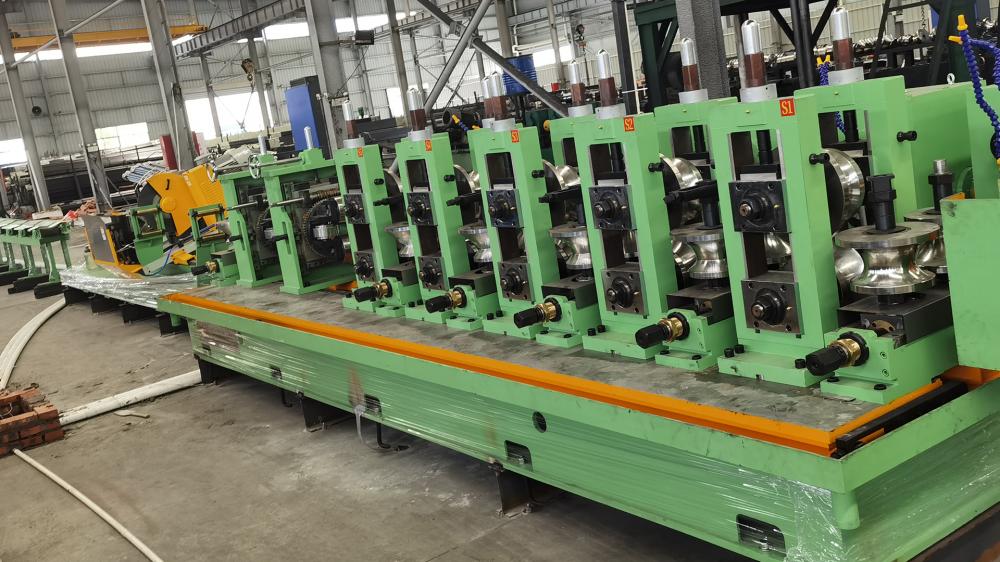
Anyone who's run a tube mill knows the bottleneck isn't the steel—it's the forming section. Traditional mills rely on multi-stand configurations that consume floor space and demand frequent manual intervention for roll changes and adjustments. Each size changeover costs hours. Each misalignment costs scrap. And every minute the line isn't running at peak speed eats into margin.
Modern high-speed Steel Tube Mill Machine technology is rewriting that equation. Take the ERW steel tube mill machines now hitting the market: tube mill speeds are running 40% higher than conventional peers, with yields exceeding 98%. The leap comes from integrating advanced servo-driven systems and customizable tooling that shape steel coils into robust tubes with minimal material waste. Some HF tube mills now achieve line speeds exceeding 120 meters per minute for light-gauge tubes. For a production manager running high-volume orders, that's the difference between meeting a deadline and missing it.
The real breakthrough lies in roll forming technology. Unlike traditional forming methods that require multiple passes and frequent recalibration, advanced roll forming machines incorporate Direct Square Forming Technology, eliminating the need for round-to-square conversion and saving both tooling and time. Modern systems have evolved from basic 8-stand configurations to sophisticated 24-stand mills capable of processing tube sizes from 10x10mm to 150x150mm, with production speeds exceeding 40 meters per minute while maintaining dimensional tolerances within ±0.1mm. IoT sensors now provide millimeter-level monitoring of material thickness and roller alignment during continuous operation.
The forming section itself—the heart of any Roll Forming Machine—has seen dramatic improvements. Hardened tool steel rollers with nano-ceramic coatings, servo-controlled gap adjustment with ±0.01mm resolution, and quick-change cartridge systems enable complete profile transitions in under 30 minutes without crane assistance. That means less downtime, more run time, and a production line that adapts to changing orders without grinding to a halt.
What about Aluminum Tube production? The same roll forming principles apply, but the material demands a different touch. Aluminum's lightweight and corrosion-resistant properties make it ideal for aerospace, construction, and automotive applications. But processing aluminum requires machines that minimize surface scratches and maintain dimensional accuracy—smooth forming rolls, precise speed control, and adaptive calibration to handle aluminum's unique characteristics. A Roll Forming Machine that handles both steel and aluminum opens up production flexibility that single-material mills simply can't match.
For a plant manager staring down rising labor costs and tighter delivery windows, the math is straightforward. A high-speed Steel Tube Mill Machine with advanced roll forming technology doesn't just produce more tubes per shift. It produces better tubes, with less waste, fewer changeovers, and a maintenance team that isn't constantly chasing adjustments. The 40% output boost isn't a marketing claim—it's what happens when you stop fighting the machine and start letting the technology work.