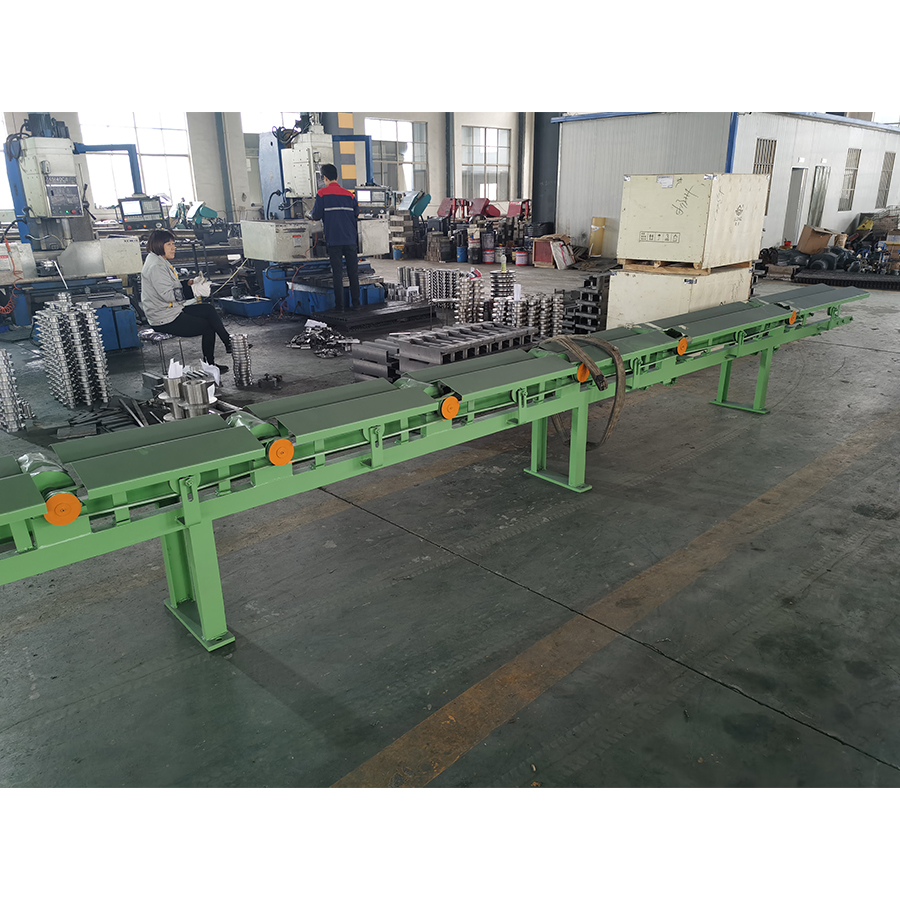
Our recently upgraded double-side run out table was engineered precisely for this threshold. The table uses dual independently driven roller strands, each with its own variable-frequency drive. When a coil exits the last stand, sensors detect its leading edge and trigger the table to accelerate from idle to match speed instantly. At 120 m/min, the transfer is so smooth that operators report no visible jerking or side-slipping—critical for maintaining surface quality on thin-walled products. The secret lies in the roller pitch: we tightened it to 250 millimeters, ensuring at least three rollers support the shortest coil at any moment, preventing droop that would cause tracking errors.
But a run out table does not work in isolation. It sits within a chain of auxiliary equipment—shears, quenching boxes, coil wrapping stations, and walking beam conveyors. Our table’s control system talks directly to these upstream and downstream units via a shared PLC network. For example, if the quench box signals a pressure drop, the table automatically reduces its feed rate momentarily, preventing the hot coil from entering an under-cooled zone. This coordination is what turns a collection of machines into a reliable production line.
Material type matters more than most engineers admit. An aluminum tube coming off the mill at 120 m/min is lighter but more prone to thermal expansion and surface marking. Our rollers are coated with a polyurethane sleeve that absorbs minor shocks and leaves no marring, even on soft 6063 alloys. Conversely, a steel tube mill machine processing heavy-gauge carbon steel requires higher roller hardness and tighter bearing clearances to handle the impact. The double-side table accepts interchangeable roller cartridges—urethane for aluminum, hardened steel for steel tubes—so a single mill can switch product without swapping the entire table frame.
Field data from a Taiwanese seamless tube plant confirms the numbers: after installing our system, coil transfer-related downtime dropped from 2.3 hours per shift to under 15 minutes. Rejection rates due to surface scratches fell by 70%. And the table’s modular design means maintenance crews can replace a damaged roller in less than ten minutes—a far cry from the half-day ordeal older units demanded. At 120 m/min, every second counts. Our table makes sure those seconds translate into saleable meters, not scrap.