In most heavy infrastructure project specifications, a "big diameter" pipe starts at 16 inches (406 mm) outside diameter and can run up to 60 inches. For offshore platforms, bridge piers, and transmission pipelines, this size range is non-negotiable. Wall thickness for these diameters routinely falls between 6 mm and 50 mm. The combination of diameter, wall thickness, and length determines which forming and welding process is technically and economically viable.
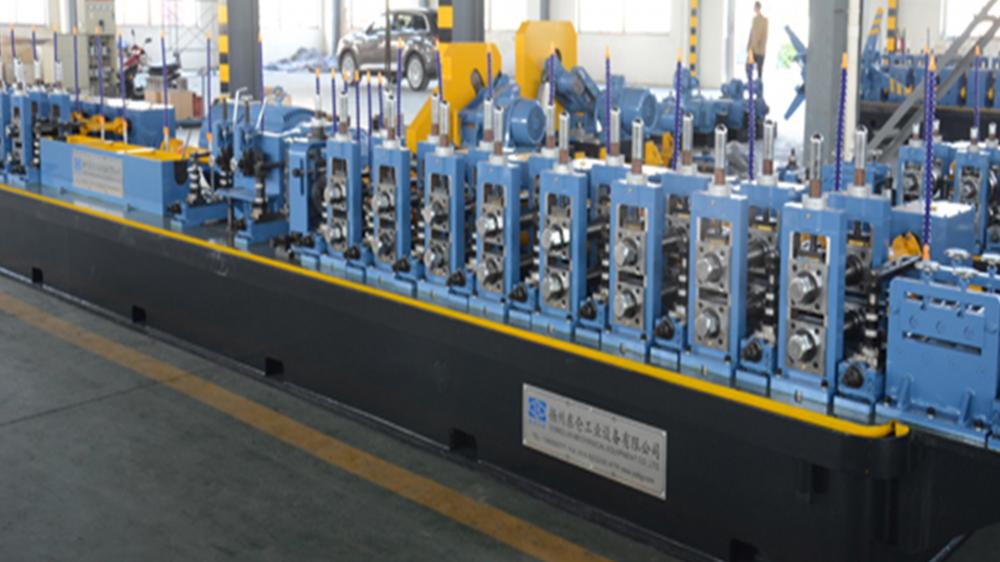
Enter the heavy-duty Steel Tube Mill Machine. These aren't the compact lines that turn out furniture legs or handrails. An industrial steel tube mill is a heavy-duty manufacturing system designed to produce steel pipes and tubes for structural, mechanical, and industrial applications. It transforms steel strip or coil into welded pipes through a coordinated sequence: uncoiling, roll forming, high-frequency induction welding, sizing, straightening, and cutting. For 16-inch pipes, the mill must handle thicker walls, greater material weight, and tighter dimensional tolerances than smaller-diameter lines. Heavy-duty lines can go up to 16–20 mm thickness for large-diameter tubing. Some facilities now produce LSAW pipes with wall thicknesses up to 95 mm and diameters reaching 80 inches.
The forming section is where the magic—and the precision—happens. A series of forming rolls progressively bend the flat strip into a round tube. That's where the Pipe Roller earns its keep. These rollers, typically machined from tool steels like GCr15 or Cr12MOV with hardness reaching HRC 63-65, shape the strip gradually to prevent cracking or deformation. In heavy-duty lines, customized heavy-duty bearings are selected to facilitate forming and reduce material rebound. The roller setup must be precisely engineered for each diameter and wall thickness combination.
What about Aluminum Tube production? The process follows similar principles—uncoiling, forming, welding, sizing, cutting—but the material behaves differently. Aluminum's lower density makes it ideal for weight-sensitive applications like automotive and aerospace. But it's also more expensive per kilo than steel and requires different welding parameters. Steel, by contrast, offers higher weldability and more consistent final welds, making it the default choice for load-bearing structural applications where cost is a primary consideration.
For a project manager specifying pipe for an offshore jacket or a bridge pile, the heavy-duty steel tube mill machine delivers what matters: repeatable quality at scale. The rollers shape it. The welder fuses it. The sizer brings it to spec. And the pipe goes to sea.