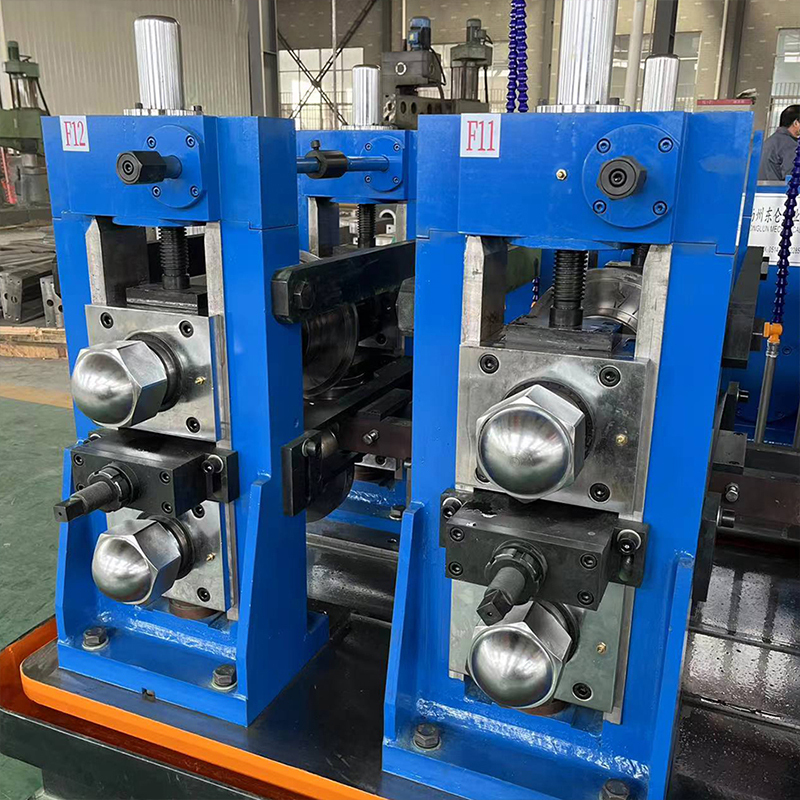
Yangzhou, a city in Jiangsu Province strategically positioned at the convergence of the Shanghai and Nanjing economic circles, has quietly built one of China's most concentrated clusters of metal forming equipment manufacturing. The Yangzhou Economic and Technological Development Zone, a national-level industrial park established in 1992 and covering approximately 133 square kilometres, now serves as the backbone of a regional machinery export machine that is reshaping how construction materials are produced across Southeast Asia and Africa.
According to industry estimates, the zone's combined annual export capacity for roll forming machines has reached 8,500 units—a figure that places Yangzhou among the world's top three export hubs for this equipment category. The numbers reflect a broader trend: China has become one of the largest producers of roll forming machines globally, with thousands of machines manufactured each year and exported to markets across North America, Europe, Africa, the Middle East, South America, and Asia. Major cities such as Wuxi, Dongguan, and Yangzhou have emerged as centres of roll forming machine manufacturing, where numerous companies specialise in designing and producing both standard and custom machines.
The Roll Forming Machine Backbone
At the heart of Yangzhou's export engine is the roll forming machine—a continuous bending system that passes metal coil through a series of rolling dies to create specific cross-sectional shapes. These machines are foundational assets for precision metal shaping across industries ranging from building envelope production to automotive structural components. The global roll forming machines and lines market was valued at USD 1.01 billion in 2025 and is projected to reach USD 1.05 billion in 2026, with a compound annual growth rate of 4.66%. The broader automatic roll forming machine market, valued at USD 7.01 billion in 2025, is expected to grow to USD 11.44 billion by 2032.
Yangzhou manufacturers have capitalised on this demand by offering machines that serve construction markets across Africa, Southeast Asia, the Middle East, and Latin America. Corrugated and trapezoidal roll forming machines are among China's highest-volume exports from the region, while adjustable C/Z purlin machines, floor decking systems, and sandwich panel production lines round out the product portfolio.
The Aluminium Tube Connection
Beyond the roll forming machine itself, Yangzhou's industrial ecosystem has developed deep expertise in aluminium tube production equipment. The global aluminium tubes market was valued at USD 3.57 billion in 2025 and is projected to grow to USD 5.39 billion by 2034, registering a compound annual growth rate of 4.74%. Yangzhou manufacturers have responded by developing high-frequency welded aluminium radiator tube production lines that incorporate world-class forming technology. These systems use cold-forming and high-frequency welding to produce lightweight, corrosion-resistant tubes for automotive and aerospace applications.
Yangzhou Donglun Industrial Equipment Co., Ltd., one of the zone's key players, has developed an independently engineered HG series steel pipe machine production line alongside multifunctional rolling forming equipment and high-precision aluminium tube solutions. The company's equipment continues to serve the global warehousing and logistics industry with what it describes as "excellent performance and stable quality". For manufacturers supplying steel or aluminium tubing, the roll forming machine has become "no longer optional" but essential infrastructure.
The Steel Tube Mill Machine Anchor
The third pillar of Yangzhou's metal forming export capacity is the steel tube mill machine. The global tube mill line market is poised for growth, with projections indicating a compound annual growth rate of 3.2% from 2025 to 2035, driven by increasing demand for welded and seamless steel pipes in construction and infrastructure sectors. The broader tube mill market, valued at USD 6.63 billion in 2024, is expected to reach USD 10 billion by 2035.
Yangzhou is home to multiple manufacturers specialising in ERW (electric resistance welding) tube mills and steel pipe making machinery. XFX Tube Mill Machinery, a factory based in Yangzhou, designs and manufactures high-frequency welded tube mills, ERW tube mill machines, and auxiliary equipment for overseas B2B customers. Yangzhou Mivi Machinery Manufacturing Co., Ltd., located in the Dayi Industrial Park with a 25,000-square-metre facility, has over 20 years of exporting experience and produces tube mill machines, cold rolling mills, and related mechanical accessories.
Orders for heavy-duty forming systems have climbed 35% year-over-year, driven primarily by solar tracker frameworks and wind turbine support structures. These systems process low-alloy steels at speeds exceeding 200 feet per minute while maintaining wall thickness variations under 0.005 inches.
The Export Infrastructure
Yangzhou's rise as a supply hub is not accidental. The zone contains an export processing zone built in 2006, designed to improve international commerce capabilities. The city's port advantages have made it a critical node in China's machinery export network—Yangzhou Port ranks first in China for the export of complete wind turbine units. This logistics infrastructure, combined with proximity to Shanghai and Ningbo ports, allows manufacturers to ship machines in 20-foot or 40-foot containers with lead times ranging from 30 to 90 days depending on complexity.
Chinese manufacturers have extensive experience exporting equipment internationally, with factories regularly shipping machines to customers across Europe, North America, Africa, the Middle East, and South America. This export experience means manufacturers understand the requirements for international shipping, export documentation, and container packaging.
The Competitive Edge
What sets Yangzhou apart is not just volume but integration. The city's manufacturers benefit from China's integrated industrial supply chains—structural steel frames, roll tooling, bearings, electric motors, hydraulic systems, and control systems are all produced domestically. This reduces both production time and manufacturing costs. The availability of a large engineering workforce allows manufacturers to design machines for a wide variety of profiles and applications.
As the global market for metal forming equipment continues to expand, Yangzhou's position as a supply hub for Southeast Asia and Africa appears secure. The region's manufacturers are not merely meeting demand—they are shaping how construction materials are produced across two of the world's fastest-growing infrastructure markets. With 8,500 roll forming machines leaving the zone annually and a full ecosystem of aluminium tube and steel tube mill equipment supporting them, Yangzhou has earned its place in the global machinery supply chain.