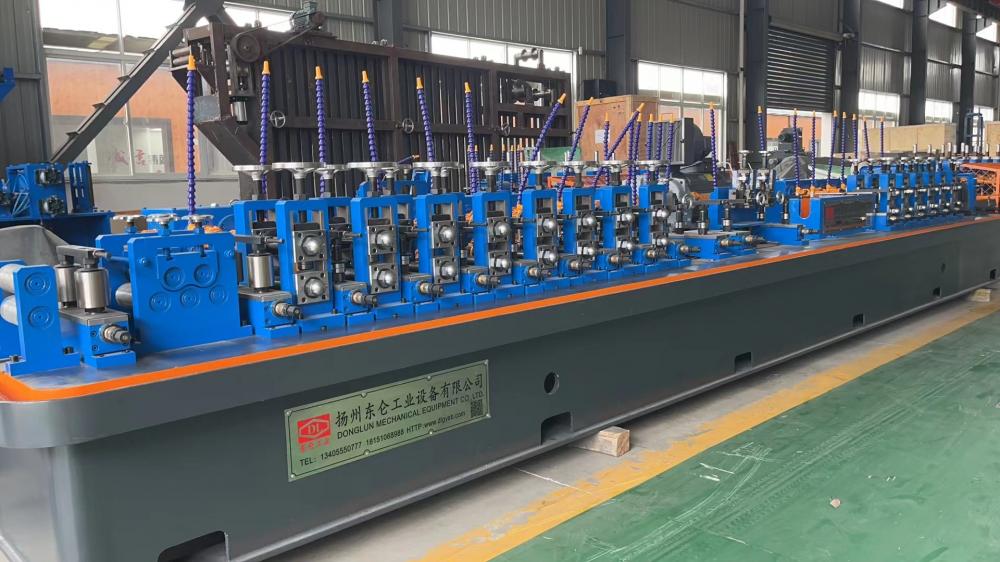
The modern Steel Tube Mill Machine is a symphony of high-torque drives, precision forming stands, and rapid-fire welding stations. But performance begins not with speed, but with rigidity. Machine frames that flex under load produce inconsistent wall thickness and ovality, leading to scrap rates that can exceed 15% on high-strength materials. Buyers should demand actual deflection data under full load, not theoretical calculations. A mill that holds tolerance at 80% capacity but drifts at 100% is a mill that will cost you in rework and downtime.
Material versatility is another make-or-break factor. As construction and automotive sectors increasingly specify lightweight components, the ability to process Aluminum Tube alongside steel has become a competitive necessity. However, aluminum behaves differently—higher thermal expansion, lower lubricity, and greater susceptibility to surface scoring. Mills equipped with independent drive controls and interchangeable forming cassettes allow operators to switch materials without sacrificing precision. Single-drive mills, by contrast, force compromises that manifest as chatter marks and dimensional drift.
Equally critical is the Pipe Roller system—often the most neglected component in procurement decisions. Rollers determine surface quality, dimensional consistency, and tooling lifespan. Buyers should inspect roller metallurgy: cast iron wears faster but costs less upfront; tool steel with carbide inserts costs more but delivers ten times the service life on abrasive materials. Adjustable roller gap mechanisms with digital position readouts are non-negotiable for mills handling multiple gauges.
Safety, however, remains the non-negotiable baseline. Modern mills integrate light curtains, emergency stop pull-cords at every operator station, and automated shutdown sequences that halt drives within 0.5 seconds of fault detection. Buyers should verify compliance with EN and ANSI standards, not through certification paperwork alone, but through witnessed operational tests.
The takeaway? Investment decisions driven by price alone invite expensive lessons. Smart buyers inspect, measure, and test—because the true cost of a mill reveals itself not on the purchase order, but on the production floor.