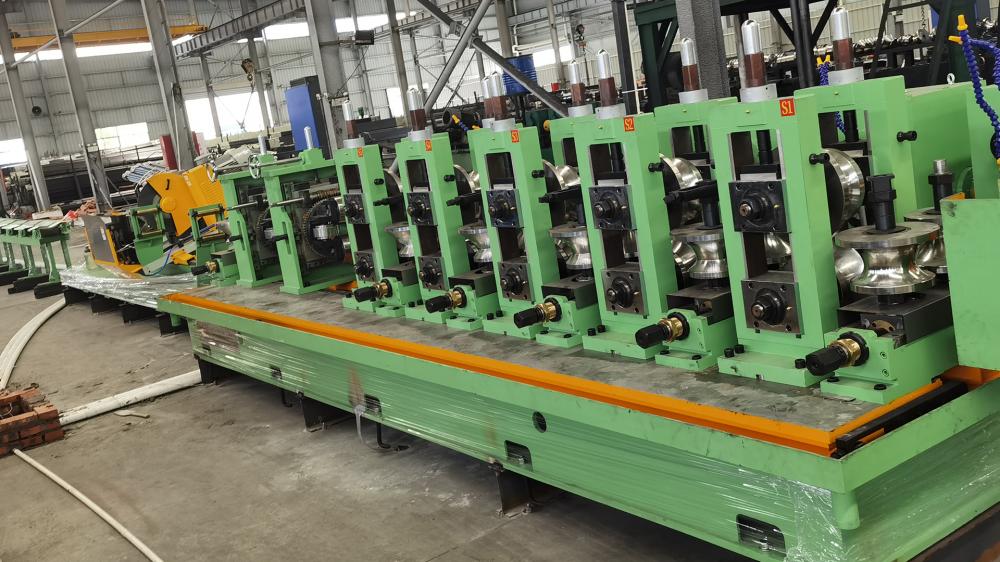
For decades, tube manufacturers accepted a painful reality: changing a steel tube mill machine from round to square profiles meant shutting down production for four to six hours. Operators manually swapped rollers, shimmed gaps, and tweaked alignments—a labor-intensive ritual that consumed half a shift and invited human error. For job shops running multiple sizes daily, that downtime translated directly into lost revenue.
That math is finally changing. Quick-change cassette systems are now reducing changeover time to under 45 minutes—and in some cases, as little as 20 minutes. The principle is simple: instead of adjusting individual rolls on the main spindle, the entire set of forming tools is pre-assembled offline in a modular cassette. When a profile change is needed, the old cassette slides out on guide rails and the new one locks into place. Pneumatic quick-release couplings and hydraulic positioning pins ensure millimetric accuracy without manual tuning.
The impact on production economics is substantial. A standard changeover on a traditional tube mill demands two workers for three to four hours—six to eight labor hours per change. A cassette changeover requires one worker for 15 minutes. For a plant running five profile changes per week, that's over 30 hours of labor saved weekly. More importantly, the rapid swap means manufacturers can run smaller batch sizes, reduce inventory, and respond to customer orders in days rather than weeks.
The flexibility extends beyond steel. The same modular platforms now accommodate aluminum tube production through interchangeable roller sets and adjusted welding parameters. Aluminum's higher thermal conductivity demands precise heat control—capabilities built into modern PLC-driven servo controls.
What many overlook is the upstream connection: the roll forming machine that feeds the tube mill. Quick-change cassette technology is equally transformative there. Cassette-type roll forming machines allow one machine frame to hold all profiles—each with its own pre-set cassette. The operator buys one machine and adds cassettes as the product range grows.
For manufacturers still running 1990s-era equipment, the payback period for retrofitting a quick-change system often falls under 18 months. As one industry observer put it: "Time saved on the shop floor is margin earned". In a business where downtime is the enemy of profit, under-45-minute changeovers are no longer a luxury—they're a competitive necessity.